

.svg)


.jpg)
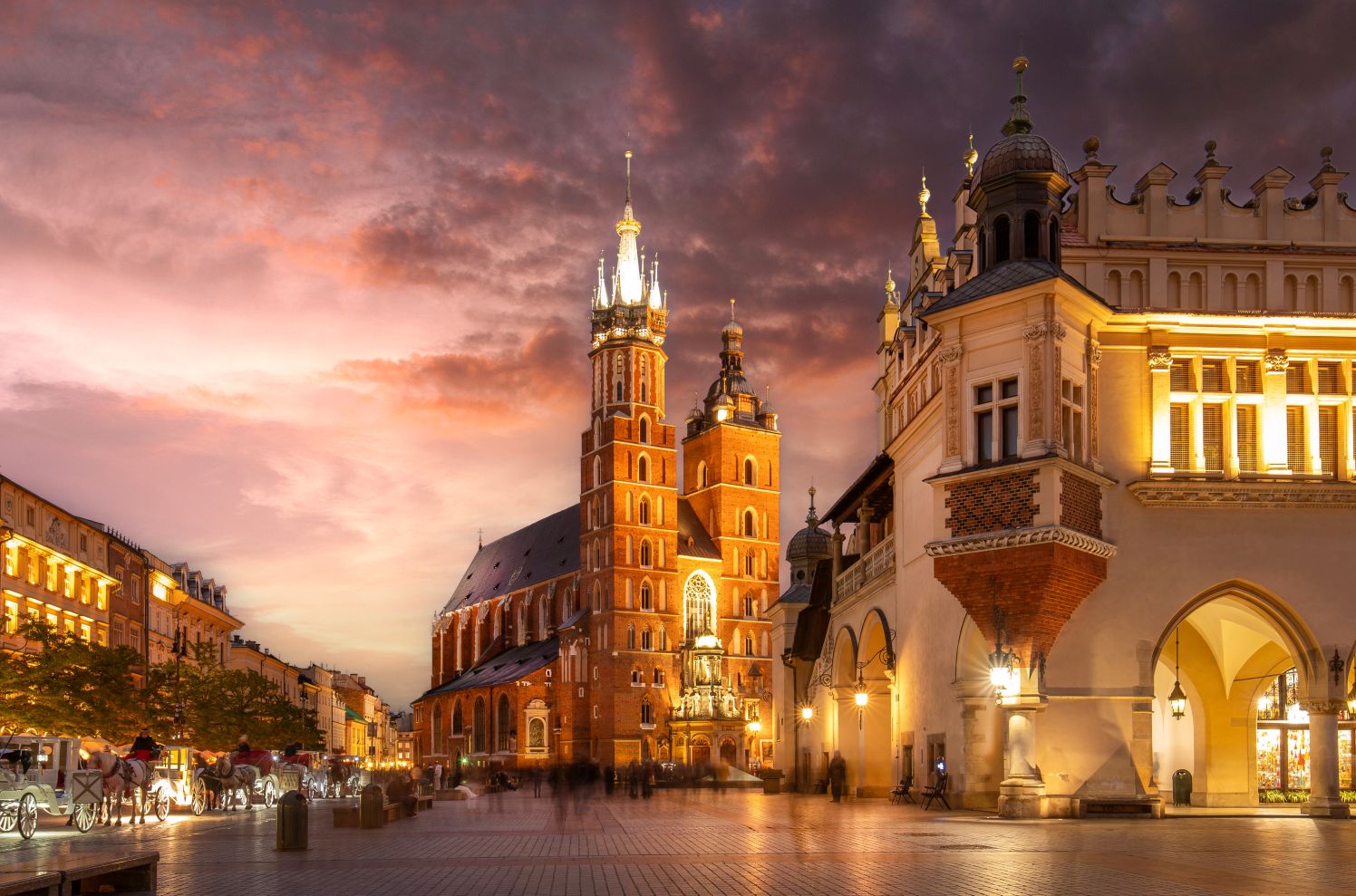
Approach Kraków from the air and the first thing you notice is how intact it is. Where Warsaw was flattened and rebuilt, Kraków survived the twentieth century with its medieval heart untouched, and the result is a city that feels ancient in a way few European capitals still do. The Rynek Główny, the main market square, is the largest in medieval Europe, and standing at its centre, with the Cloth Hall on one side and the mismatched towers of St Mary's Basilica on the other, you understand why Poles regard this as their true cultural capital. But Kraków is not a city preserved in aspic. Its student population is enormous, its restaurant scene has quietly become one of the most interesting in central Europe, and Kazimierz, the old Jewish quarter, has transformed into the kind of neighbourhood that other cities try, and fail, to manufacture.
Getting there and getting around
John Paul II International Airport at Balice lies 11 kilometres west of the Old Town, and the transfer is mercifully short. There is a train to the main station that takes around 20 minutes, but taxis at the rank can be unreliable and the pricing opaque, so a pre-arranged car is the better choice for a stress-free arrival. Airport Executive's Kraków chauffeurs meet every flight in the terminal, track delays so nobody is left waiting, and will have you at your hotel door in 25 minutes. They also know which of the Old Town's restricted streets can actually be accessed by car, which is not obvious, and will be back at the hotel for the return to Balice whenever you choose to leave.
Within the city you need nothing but your feet and, occasionally, a tram. The Old Town, Wawel and Kazimierz sit in a line along the Vistula, and you can walk from the Barbican at the northern gate to the synagogues of Kazimierz in half an hour. The Planty, the ring of gardens where the medieval walls once stood, is the loveliest way to circle the centre.
Where to stay
Hotel Stary, in a sixteenth-century townhouse a minute from the square, remains the finest address in the Old Town, with a rooftop terrace looking over the tiled roofs and a swimming pool set into the vaulted cellars. The Copernicus, on Kanonicza, the most beautiful street in the city, is where heads of state stay when they visit Wawel, with Renaissance frescoes on the bedroom walls and a quiet courtyard for breakfast.
For something more contemporary, Hotel Unicus Palace has taken a grand building near the Planty and given it a cool, pale-stone modern interior with one of the city's best spas. In Kazimierz, Hotel Metropolitan is a well-run boutique option in the middle of the action, and PURO Kraków Kazimierz, part of the excellent Polish design-hotel group, is bright, well priced and has a rooftop bar that fills up at sunset. If you would rather be by the river, the Sheraton Grand sits on the Vistula bank beneath Wawel and the views from the upper floors are worth the slight walk.
What to see
Wawel Hill first. The castle and cathedral on the limestone bluff above the river are the closest thing Poland has to Westminster, the coronation and burial place of its kings, and the Sigismund Chapel, with its gilded dome, is one of the great works of the Italian Renaissance north of the Alps. Book a timed ticket for the State Rooms in advance, and do not miss the Leonardo, the Lady with an Ermine, which hangs in the Czartoryski Museum a few streets away and is, arguably, a more intimate encounter than the Mona Lisa.
On the market square, climb the tower of St Mary's on the hour to hear the hejnał, the trumpet call that stops mid-note in memory of a medieval watchman felled by a Tatar arrow, and step inside for the Veit Stoss altarpiece, a late-Gothic carved masterpiece twelve metres high. Beneath the square, Rynek Underground is an unexpectedly good archaeological museum built around the excavated medieval market.
Then walk south into Kazimierz. For centuries the separate Jewish town of Kraków, it fell into ruin after the war and has spent the past three decades becoming the city's creative heart. The Old Synagogue and the Remuh Synagogue with its cemetery are moving, quiet places. Across the river in Podgórze, the site of the wartime ghetto, Schindler's Factory is now a superb museum of Kraków under occupation, and the empty chairs in Plac Bohaterów Getta are among the most affecting memorials in Europe.
Auschwitz-Birkenau lies 70 kilometres west and most visitors make the journey. Go with a private guide and a car rather than a coach tour; it gives you time and silence, both of which you will need. Airport Executive can arrange a chauffeur for the day, with a driver who waits while you visit and takes you on to Wieliczka or back to the city at your own pace. The Wieliczka Salt Mine, 14 kilometres south-east, is a lighter excursion, a subterranean world of chapels and chandeliers carved entirely from salt, and can be combined with Auschwitz in a long but manageable day.
Where to eat and drink
Kraków's restaurant scene has moved a long way beyond pierogi, though the pierogi are still excellent. Bottiglieria 1881, in a Kazimierz cellar, holds two Michelin stars and serves a tasting menu that reinterprets Polish ingredients with real confidence; it is the most exciting table in the country. Pod Nosem, on Kanonicza, is an elegant, wood-panelled place for refined Polish classics, and Szara Gęś, on the square, does duck and goose beautifully in a vaulted Gothic room.
For the honest, everyday food that Poles actually eat, seek out a milk bar. Bar Mleczny Pod Temidą, near the university, serves żurek, the sour rye soup, and plates of pierogi with fried onions for a few złoty, at communal tables, with no ceremony whatsoever. Pierogarnia Zapiecek and Przystanek Pierogarnia both do dumplings well, and Zapiekanki, the open baguettes topped with mushrooms and cheese sold from the round hall at Plac Nowy in Kazimierz, are the city's late-night ritual.
Kazimierz is also where you drink. Alchemia, on Plac Nowy, is candlelit, cluttered and has barely changed in twenty years. Singer, with its sewing-machine tables, is next door. Mleczarnia has a courtyard garden strung with lights. For cocktails, Movida in the Old Town is the polished option, and for vodka, which you should take neat, ice-cold and with something to eat, Wódka Café Bar on Mikołajska is a tiny room with an encyclopaedic list.
Coffee has become a serious business here. Karma on Krupnicza, Wesoła Café near the station and Tektura in Kazimierz are all worth the detour, and Cafe Camelot, with its folk-art interior and cheesecake, is the old-guard favourite.
The Kraków nobody tells you about
Cross the Bernatek footbridge from Kazimierz into Podgórze and keep walking. This side of the river is where the city is heading: Zabłocie, the former industrial quarter around Schindler's Factory, has become a district of galleries, breweries and the MOCAK contemporary art museum. Up the hill, Krakus Mound is a prehistoric earthwork with the finest view of the city, and almost nobody goes.
On a summer evening, hire a bike and ride the Vistula boulevards west from Wawel towards the Zwierzyniec district, past the Norbertine convent and up to the Kościuszko Mound, or join the crowds on the riverbank below the castle where the barges have been turned into bars. And if you have a spare day, drive an hour south to Zakopane and the Tatra mountains, where the wooden highland architecture and the smoked oscypek cheese make you feel you have crossed into another country entirely.
When to go
May and June, when the lime trees on the Planty are in flower and the outdoor terraces open, are close to perfect. September and early October are golden and calmer. December brings a Christmas market on the square that is smaller and more charming than Vienna's, and the city under snow is beautiful, though bitterly cold. Avoid the first weekend of June, when the Jewish Culture Festival and the university's end of term make hotels scarce, unless you have booked well ahead.
Getting there without the fuss
Kraków is an easy city to love and, with the right arrangements, an easy one to reach. Airport Executive has a chauffeur waiting at Balice when you land, with a fixed price agreed before you travel and the car following your flight if it runs late, and the same service back to the airport at the end of the trip. Day cars for Auschwitz, Wieliczka or the Tatras can be added to the booking. Reserve your Kraków transfers at airportexecutive.com and start the trip the moment you close the front door.
Book your Kraków airport transfer here or call our reservations team on +44 (0)208 838 3333.
Airport Executive, a better way to travel.