

.svg)


.jpg)

You've confirmed the flights. You've booked the hotel. You've blocked the calendar and briefed the client. But there's one part of the journey that often gets handled last, and it's the part your executive will notice first and last - Ground transport.
For PAs and EAs managing corporate travel, getting this piece right isn't just about logistics. It's about protecting your executive's time, your company's reputation, and your own sanity when things don't go to plan. This guide covers what you actually need to know.
Why Ground Transport Deserves a Proper Policy
Most companies have clear policies on flights, hotels, and expenses, but ground transport often falls into a grey area. The result? Inconsistent bookings, unexpected costs, and the occasional executive stranded at Heathrow because the Uber surge-priced to £90 and the driver cancelled twice.
A clear, written ground transport policy removes ambiguity. It tells travellers what is and isn't reimbursable, sets expectations on service level, and gives PAs and EAs a defensible framework when being challenged on spend.
If your company doesn't have one yet, this article is a good starting point.
Licensing: The Detail Most People Miss
Not all private hire vehicles are the same, and in London, the difference matters legally.
Any vehicle carrying passengers for hire in London must be licensed by Transport for London (TfL). This applies to the vehicle, the driver, and the operator. A TfL-licensed operator is held to rigorous standards covering driver background checks, vehicle condition, insurance, and complaint handling.
When you book through a TfL-licensed operator like Airport Executive (Operator Licence 402), you have a formal, regulated service with clear accountability. When you book through an unlicensed or inadequately licensed provider, whether through a consumer app or an informal arrangement, that protection disappears, often without you realising it.
What to check when approving a ground transport supplier:
- Do they hold a valid TfL Operator Licence? (Easily verifiable on the TfL website)
- Are their drivers individually licensed?
- Do they carry appropriate hire and reward insurance?
- Do they have a formal complaints process?
If a supplier can't answer all four clearly, look elsewhere.
Understanding Service Tiers and When to Use Each
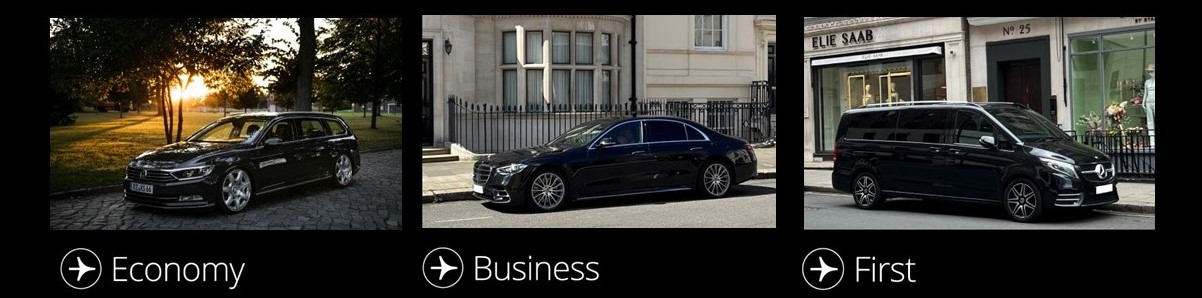
Corporate ground transport generally falls into three categories. Knowing the difference helps you match the booking to the occasion.
Economy Class: A professional, comfortable saloon or estate, typically a VW, Tesla or equivalent. Suitable for solo business travel, airport runs, and routine point-to-point journeys. Clean, punctual, and cost-effective.
Business Class: A premium executive vehicle, typically a Mercedes E-Class or equivalent. Appropriate for senior executives, VIP clients, or situations where presentation matters. The interior environment is noticeably superior, quieter, more spacious and better suited to working on the move.
First Class: Our highest tier, reserved for VIP travel and occasions where the journey itself is part of the experience. Vehicles include the Mercedes S-Class and bespoke modified versions of the Mercedes V-Class, fitted with aircraft-style reclining seats, enhanced privacy, and premium cabin finishes. For board-level visits, high-profile guests, or executives who need to arrive composed and ready, this is the appropriate choice.
A good travel policy will specify which tier is appropriate for which traveller grade or journey type. This prevents awkward conversations and ensures spend is proportionate.
Airport Transfers: The Specifics That Save Time
Airport runs are the most common corporate ground transport booking, and the most likely to go wrong without proper planning.
Flight tracking matters. A professional chauffeur operator will monitor your executive's flight in real time and adjust pick-uptime automatically if the flight is delayed. This should be a baseline expectation, not a premium add-on. Always confirm this is included when booking.
Meet and greet vs. kerbside. For arrivals, a meet-and-greet service means your driver is inside the terminal, name board in hand, ready at the arrivals gate. For senior executives or international visitors, this is the correct choice. Kerbside pick-up (driver waits outside)is cheaper but requires the passenger to navigate the terminal themselves and find the vehicle, fine for regular travellers, less appropriate for guests.
Waiting time policy. Reputable operators include a standard free waiting period after landing (typically 60 minutes) to allow for immigration and baggage. Understand what your operator includes before the booking, not after the invoice.
Airport charges. Terminal drop-off and pick-upcharges at Heathrow and Gatwick have increased significantly. Gatwick alone has increased its drop off charge by 67% in the last year. These are legitimate pass-through costs and should be itemised on your invoice. If they're not shown, they're being absorbed silently into the fare, or worse, not paid at all.
Managing Corporate Accounts: What to Ask For
If your company books ground transport regularly, a corporate account is worth establishing. Here's what a well-run corporate account should offer:
- Consolidated monthly invoicing: One invoice covering all journeys, with clear job references, rather than individual receipts per trip
- Named account management: A contact who knows your preferences and can handle urgent bookings
- Passenger reporting: A breakdown by traveller, journey type, and cost centre, useful for internal reconciliation
- Fixed or agreed rates: Agreed pricing for common routes (e.g. Central London to Heathrow) removes fare variability and simplifies budgeting
- VAT-compliant invoicing: Essential for reclaiming input VAT on business journeys; ensure your supplier is VAT-registered and provides proper tax invoices
At Airport Executive, corporate accounts are exempt from the Admin Booking Fee that applies to individual bookings, a straightforward saving for regular clients. We also offer 14 day payment terms.
The One Thing Most Travel Companies Have Quietly Removed
Here's something worth saying plainly: a significant number of travel and transport companies have replaced their customer service teams with chatbots, automated responses, and self-service portals. For routine queries, this is manageable. For anything time-sensitive or genuinely urgent, a missed connection, a confused driver, an executive about to miss a meeting, it is deeply frustrating.
As a PA or EA, you already carry a great deal of pressure on behalf of the people you support. The last thing you need when something goes wrong at 8pm is to be typing into a chat window, waiting for an automated response that doesn't understand the question.
“At Airport Executive, we have made a deliberate choice to do things differently. Our phones are answered by real people, in seconds, not minutes, not after navigating a menu, not via a call back system. When you call us, you speak to someone who knows the business, knows your booking, and has the authority to actually help”. — Chris Nixon, CEO, Airport Executive
Chris continues, "We think this is simply how a premium service should work. But we also know it's become rarer than it should be, which is why it's worth mentioning explicitly when you're evaluating ground transport suppliers".

When assessing any ground transport provider, ask these questions:
- Is there a direct phone number, answered by a human, during all operating hours?
- What is their average response time to an urgent query?
- Who do you contact if something goes wrong mid-journey?
- Can decisions be made on the spot, or does every exception require a manager call back?
The answers will tell you a great deal about how that company will perform under pressure.
When things do go wrong , and in travel, they sometimes will, we pride ourselves on being flexible and fair. We don't hide behind small print. We make sensible decisions quickly, treat every situation on its merits, and make sure you're never left feeling like you're fighting the company you're supposed to be working with.
For a PA or EA, that kind of relationship with a supplier isn't a luxury. It's a professional necessity.
Handling the Unexpected: Your Contingency Checklist
Even the best-planned journey can be disrupted. Here's how to prepare:
If there's a strike or major disruption: TfL industrial action, Eurostar delays, or severe weather can cause acute demand spikes for private hire. Having a standing relationship with a licensed chauffeur operator means you're not competing for availability on a consumer app. Pre-book as early as possible during known disruption windows.
If the executive's plans change last minute: Know your operator's cancellation policy before you need it. Most reputable operators will provide a reasonable free cancellation window. Understanding this in advance means you can make changes confidently rather than absorbing avoidable charges.
If the driver doesn't show: A licensed operator has a duty of care and a complaints process. Document the time, the booking reference, and any contact attempts, then request a formal response. With an app-based service, this process is often opaque and frustrating. With a licensed operator, there is a clear chain of accountability.
A Note on Expenses and VAT
For PAs and EAs managing expense submissions, ground transport can create VAT complexity, particularly when journeys cross betweenLondon and the rest of the UK.
The simple rule: ensure every invoice you receive includes the supplier's full legal name, address, VAT registration number, a descriptionof the service, and the VAT amount shown separately. Without these, VAT cannot be reclaimed.
If your company travels internationally, be aware that transfers booked through a UK operator for journeys taking place overseas are typically zero-rated, meaning no UK VAT applies. Your operator should reflect this correctly on the invoice.
When in doubt, loop in your finance team before approving anew supplier.
Building Your Ground Transport Policy: A Simple Framework
If you're putting a policy together from scratch, or updating an existing one, here are the core elements to cover:
- Approved suppliers: Name your preferred licensed operators and make clear that bookings should be made through them
- Service tier guidance: Define which vehicle category applies to which traveller grade or occasion
- Booking lead time: Set a minimum notice period (24 hours is reasonable for standard bookings; longer for events or group travel)
- Reimbursement limits: Set clear per-journey caps or approved route pricing
- Receipt and VAT requirements: Specify what documentation is needed for expense claims
- Out-of-hours contact: Ensure there's a number to call if something goes wrong at 6am
A one-page policy covering these six points will resolve the majority of ground transport questions before they reach your inbox.
Working With Airport Executive
Airport Executive operates across London and the UK, providing licensed chauffeur services for business and corporate clients. Our corporate accounts offer consolidated billing, fixed route pricing, and a dedicated point of contact, designed specifically to make life easier for PAs, EAs, and travel managers.
We also take the headache out of arranging onward transfers, with partner agreements in place across more than 50 countries. So whether your executive is heading to a meeting in Munich or a conference in Singapore, one call to us handles the ground transport at both ends.
And because we know your time is precious, we keep communication simple. Reach us via WhatsApp for quick bookings, itinerary updates, and complex multi-leg journeys, no cumbersome online forms, no double entry, no back-and-forth. Just straightforward, efficient communication with people who are genuinely here to help take the strain.
We operate under TfL Operator Licence 402 and our fleet covers Economy, Business, and First Class categories to suit every journey type and traveller grade.
To discuss a corporate account or make a booking, contact us here.
Airport Executive - London's Premium Chauffeur Service